
Key Takeaways:
- Last-mile delivery is the final step from warehouse to customer.
- It has the biggest impact on delivery speed and experience.
- Costs are highest in this stage of the delivery journey.
- Technology helps improve efficiency and reduce delays.
What Is Last-Mile Delivery?
Last-mile delivery refers to the final stage of the shipping process, where a package moves from a local distribution hub to the customer’s doorstep. It is the last interaction in the delivery journey and often determines how customers judge the entire experience. While earlier stages focus on storage and transport, this stage focuses on speed, accuracy, and convenience.
You’ll often hear it called final mile delivery or last mile shipping. All terms describe the same concept. In modern ecommerce and logistics, this stage has become more important as customers expect faster and more reliable delivery times across every order.
How the Last-Mile Delivery Process Works
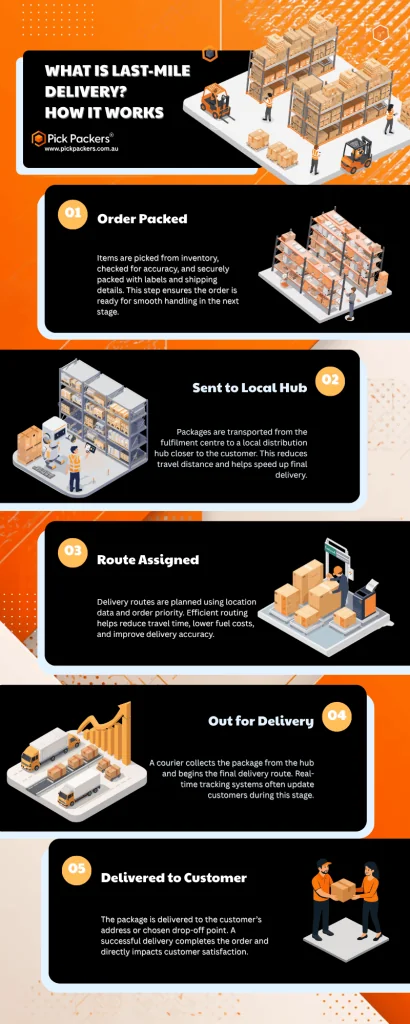
Last-mile delivery begins once an order leaves a fulfilment centre and moves toward the customer. Each step focuses on getting the package delivered quickly and accurately within a local area.
The process usually follows these steps:
- The order is packed and dispatched from a warehouse
- The package is sent to a local distribution hub
- A delivery route is assigned based on location and priority
- A courier collects the parcel for final delivery
- The package is delivered to the customer’s address
Each stage depends on accurate data and route planning. Even small delays at this stage can affect delivery timelines and customer satisfaction.
Why Last-Mile Delivery Matters
Last-mile delivery plays a major role in shaping how customers view a brand. It’s the only part of the logistics process that customers directly experience, which makes it highly visible and sensitive to delays or errors. A smooth delivery builds trust, while missed deliveries or delays can lead to negative reviews and lost repeat business.
It also affects operational costs more than any other stage. Delivering individual orders across different locations requires more time, labour, and fuel compared to bulk transportation. Businesses that manage this stage well often gain an advantage through faster delivery and stronger customer loyalty.
Key Challenges in Last-Mile Logistics
Last-mile logistics comes with several operational challenges that can affect both cost and performance. These issues often increase as delivery volumes grow and customer expectations rise.
Some of the most common challenges include:
- High delivery costs due to individual shipments
- Traffic congestion and inefficient routing
- Failed delivery attempts when customers are unavailable
- Limited visibility into delivery status
- Difficult access in rural or remote areas
Each of these challenges can slow down delivery or increase expenses. Businesses that rely heavily on ecommerce must address these issues to stay competitive.
Solutions That Improve Last-Mile Delivery
Improving last-mile delivery requires a combination of technology, planning, and infrastructure. Businesses that invest in better systems can reduce delays and control costs more effectively.
Here are some of the most effective solutions used today:
- Route optimization software to reduce travel time
- Real-time tracking systems for better visibility
- Micro-fulfilment centres closer to customers
- Delivery lockers and pickup points for flexibility
- AI tools for demand forecasting and planning
These solutions help businesses deliver faster while keeping operations efficient. As delivery expectations continue to rise, adopting these tools becomes necessary for long-term growth.
Last-Mile Delivery vs Fulfilment
Last-mile delivery is only one part of the broader fulfilment process. Fulfilment covers the entire journey from receiving inventory to shipping orders and handling returns. Last-mile delivery focuses only on the final step, where the package reaches the customer.
Understanding this difference helps businesses improve specific parts of their operations. While fulfilment systems manage inventory and processing, last-mile delivery determines how quickly and smoothly orders arrive at their destination.
Industries That Rely on Last-Mile Delivery
Many industries depend on last-mile delivery to meet customer expectations and maintain consistent operations. As online ordering continues to grow, this stage becomes even more important across different sectors.
Ecommerce businesses rely on fast last-mile delivery to compete with major retailers offering same-day or next-day shipping. Food delivery services depend on speed and timing to maintain product quality and customer satisfaction. Retail brands use it to support both online and in-store fulfilment models.
Healthcare providers also depend on reliable delivery for medical supplies and prescriptions, where timing can affect patient care. Subscription-based businesses need consistent last-mile delivery to maintain customer retention and predictable service.
Bottomline: Last-Mile Delivery
Last-mile delivery shapes how customers experience your brand at the final step of the journey. It affects delivery speed, costs, and satisfaction more than any other stage. Businesses that invest in better routing, tracking, and local distribution can deliver faster and operate more efficiently. As expectations continue to rise, improving last-mile delivery becomes a practical way to stay competitive.
Last-Mile Delivery FAQs
Understanding last-mile delivery helps businesses improve operations and customer experience. Below are answers to common questions that explain how this stage works and why it matters.
What is last-mile delivery in simple terms?
Last-mile delivery is the final step of shipping where a package moves from a local hub to the customer. It completes the delivery process and directly affects customer satisfaction. This stage focuses on speed, accuracy, and convenience, making it one of the most visible and important parts of logistics operations.
Why is last-mile delivery expensive?
Last-mile delivery is expensive because it involves individual shipments rather than bulk transport. Each delivery requires separate routing, labour, and fuel, which increases costs. Urban congestion, failed deliveries, and distance between stops also add to expenses, making this stage the most costly part of the overall logistics process.
How can businesses improve last-mile delivery?
Businesses improve last-mile delivery by using route optimization, real-time tracking, and local fulfilment hubs. These tools reduce delays and improve accuracy. Companies also use delivery lockers and flexible delivery options to avoid failed attempts, helping them lower costs while improving the overall customer experience.
What industries depend on last-mile delivery?
Ecommerce, retail, food delivery, healthcare, and subscription services depend on last-mile delivery. These industries require fast and reliable shipping to meet customer expectations. Timely delivery helps maintain product quality, customer satisfaction, and repeat business, making this stage essential for daily operations.
What is the difference between last-mile delivery and shipping?
Last-mile delivery is the final step of shipping, while shipping covers the entire transportation process. Shipping includes moving goods between warehouses and regions, while last-mile focuses on delivering the package to the customer. This distinction helps businesses improve specific parts of their logistics operations more effectively.
Ready to ship? Send us a message.

Author: Will Adlouni
Will Adlouni brings over a decade of expertise at Pick Packers, where he leads in redefining logistics with tailored solutions that save clients an average of 30% on costs. Specializing in fulfilment, e-commerce, and online logistics, Will focuses on exceeding client expectations by automating the sale-to-delivery process and offering expertise in EDI, B2B, and B2C View all posts by Will Adlouni