
Key Takeaways:
- 3PL services help businesses outsource warehousing, packing, and shipping.
- Fulfilment partners support scalable growth without owning warehouse space.
- Starting with 3PL requires clear volume, system, and service readiness.
What Are 3PL and Fulfilment Services?
3PL and fulfilment services cover the outsourced management of inventory storage, order picking, packing, shipping, and returns. Instead of running an in-house warehouse, businesses rely on a third-party provider to handle daily logistics tasks. This setup is common across ecommerce, retail, and subscription brands that need flexibility without long-term property or staffing commitments. In Australia, 3PL providers often integrate directly with online stores, allowing orders to flow automatically from checkout to dispatch.
How Does 3PL Fulfilment Works in Practice?
The process begins when stock is delivered to a fulfilment centre and recorded into a warehouse management system. Once a customer places an order, the system generates picking instructions, packing details, and carrier labels. Orders are packed, scanned, and shipped, often on the same day. Inventory updates automatically across sales channels, keeping stock levels accurate. Returns follow a similar workflow, with items inspected and restocked or flagged based on condition.
When Should Businesses Should Start Using 3PL Services?
Most businesses move to 3PL fulfilment when order volumes become difficult to manage in-house. This often happens when daily orders exceed what a small team can pack accurately or when storage space limits growth. Seasonal spikes, expanding product ranges, and rising delivery expectations also trigger the shift. For Australian ecommerce brands, outsourcing fulfilment often reduces delivery times by positioning stock closer to metro customers.
Steps to Start With 3PL and Fulfilment Services
Starting with a 3PL provider follows a structured onboarding process. Each step ensures systems, stock, and workflows align before live orders begin:
- Review order volumes, SKU count, and monthly growth trends
- Confirm platform integrations with ecommerce and inventory systems
- Define packing rules, shipping options, and service-level expectations
- Transfer inventory to the fulfilment centre and complete system testing
- Launch fulfilment with monitored orders before full-scale rollout
- Review order volumes, SKU count, and monthly growth trends
A clear setup phase prevents dispatch errors and reporting gaps later.
Costs and Considerations Before Outsourcing Fulfilment
3PL pricing usually includes storage, pick and pack fees, packaging, and shipping. Costs vary based on order complexity, item size, and monthly volume. Businesses should also factor in onboarding fees and returns handling. While outsourcing adds a service cost, it often replaces rent, labour, software, and carrier contracts. For many Australian businesses, the total cost becomes more predictable as order volumes increase.
Choosing the Right 3PL Fulfilment Partner
The right fulfilment partner supports long-term growth, not just short-term capacity. Experience with your product type, system integrations, and local carrier networks matters. Visibility is equally important. Real-time reporting allows businesses to track orders, inventory, and delivery performance without manual checks. A strong partner also adapts as order volumes change, preventing service breakdowns during peak demand.
3PL and Fulfilment Services: Bottomline
3PL and fulfilment services allow businesses to scale logistics without scaling warehouse complexity. By outsourcing storage, packing, and shipping, brands gain faster delivery, better inventory control, and predictable costs. Starting with the right setup and partner helps businesses focus on sales and customer experience while logistics runs reliably in the background.
3PL and Fulfilment Services: Frequently Asked Questions
Below are some of the most frequently asked questions we address when businesses explore 3PL and fulfilment services:
Shipping options: FAQs
Below are some of the most frequently asked questions we address when businesses explore 3PL and fulfilment services:
What is a 3PL provider?
A 3PL provider is a company that manages warehousing, order fulfilment, and shipping on your behalf. It stores inventory, picks and packs orders, and dispatches them using integrated systems. This setup reduces operational workload while maintaining accurate, trackable delivery processes for growing businesses.
How long does it take to start using 3PL services?
Most businesses can onboard with a 3PL provider within two to four weeks. This timeframe includes system integration, inventory receiving, and testing. Simple catalogues move faster, while complex products or custom packing rules may extend setup slightly to ensure accuracy before live orders.
Is 3PL suitable for small businesses?
Yes, 3PL services work well for small businesses that are growing beyond home or office fulfilment. Outsourcing removes storage and staffing limits while improving delivery speed. Many Australian providers support low minimum volumes, allowing businesses to scale gradually without large upfront commitments.
How do 3PL services integrate with ecommerce platforms?
3PL providers integrate directly with ecommerce platforms to sync orders, inventory, and tracking details automatically. Once connected, orders flow to the fulfilment centre in real time. This reduces manual data entry, prevents stock errors, and keeps customers updated throughout the delivery process.
What’s the difference between 3PL and standard shipping?
3PL services manage the entire fulfilment process, while shipping only covers transport. Fulfilment includes inventory storage, picking, packing, dispatch, and returns handling. Shipping is just one step within that workflow. Using 3PL gives businesses full operational support beyond courier delivery alone.
Key Takeaways:
- 3PL services help businesses outsource warehousing, packing, and shipping.
- Fulfilment partners support scalable growth without owning warehouse space.
- Starting with 3PL requires clear volume, system, and service readiness.
What Are 3PL and Fulfilment Services?
3PL and fulfilment services cover the outsourced management of inventory storage, order picking, packing, shipping, and returns. Instead of running an in-house warehouse, businesses rely on a third-party provider to handle daily logistics tasks. This setup is common across ecommerce, retail, and subscription brands that need flexibility without long-term property or staffing commitments. In Australia, 3PL providers often integrate directly with online stores, allowing orders to flow automatically from checkout to dispatch.
How Does 3PL Fulfilment Works in Practice?
The process begins when stock is delivered to a fulfilment centre and recorded into a warehouse management system. Once a customer places an order, the system generates picking instructions, packing details, and carrier labels. Orders are packed, scanned, and shipped, often on the same day. Inventory updates automatically across sales channels, keeping stock levels accurate. Returns follow a similar workflow, with items inspected and restocked or flagged based on condition.
When Should Businesses Should Start Using 3PL Services?
Most businesses move to 3PL fulfilment when order volumes become difficult to manage in-house. This often happens when daily orders exceed what a small team can pack accurately or when storage space limits growth. Seasonal spikes, expanding product ranges, and rising delivery expectations also trigger the shift. For Australian ecommerce brands, outsourcing fulfilment often reduces delivery times by positioning stock closer to metro customers.
Steps to Start With 3PL and Fulfilment Services
Starting with a 3PL provider follows a structured onboarding process. Each step ensures systems, stock, and workflows align before live orders begin:
- Review order volumes, SKU count, and monthly growth trends
- Confirm platform integrations with ecommerce and inventory systems
- Define packing rules, shipping options, and service-level expectations
- Transfer inventory to the fulfilment centre and complete system testing
- Launch fulfilment with monitored orders before full-scale rollout
- Review order volumes, SKU count, and monthly growth trends
A clear setup phase prevents dispatch errors and reporting gaps later.
Costs and Considerations Before Outsourcing Fulfilment
3PL pricing usually includes storage, pick and pack fees, packaging, and shipping. Costs vary based on order complexity, item size, and monthly volume. Businesses should also factor in onboarding fees and returns handling. While outsourcing adds a service cost, it often replaces rent, labour, software, and carrier contracts. For many Australian businesses, the total cost becomes more predictable as order volumes increase.
Choosing the Right 3PL Fulfilment Partner
The right fulfilment partner supports long-term growth, not just short-term capacity. Experience with your product type, system integrations, and local carrier networks matters. Visibility is equally important. Real-time reporting allows businesses to track orders, inventory, and delivery performance without manual checks. A strong partner also adapts as order volumes change, preventing service breakdowns during peak demand.
3PL and Fulfilment Services: Bottomline
3PL and fulfilment services allow businesses to scale logistics without scaling warehouse complexity. By outsourcing storage, packing, and shipping, brands gain faster delivery, better inventory control, and predictable costs. Starting with the right setup and partner helps businesses focus on sales and customer experience while logistics runs reliably in the background.
3PL and Fulfilment Services: Frequently Asked Questions
Below are some of the most frequently asked questions we address when businesses explore 3PL and fulfilment services:
Shipping options: FAQs
Below are some of the most frequently asked questions we address when businesses explore 3PL and fulfilment services:
What is a 3PL provider?
A 3PL provider is a company that manages warehousing, order fulfilment, and shipping on your behalf. It stores inventory, picks and packs orders, and dispatches them using integrated systems. This setup reduces operational workload while maintaining accurate, trackable delivery processes for growing businesses.
How long does it take to start using 3PL services?
Most businesses can onboard with a 3PL provider within two to four weeks. This timeframe includes system integration, inventory receiving, and testing. Simple catalogues move faster, while complex products or custom packing rules may extend setup slightly to ensure accuracy before live orders.
Is 3PL suitable for small businesses?
Yes, 3PL services work well for small businesses that are growing beyond home or office fulfilment. Outsourcing removes storage and staffing limits while improving delivery speed. Many Australian providers support low minimum volumes, allowing businesses to scale gradually without large upfront commitments.
How do 3PL services integrate with ecommerce platforms?
3PL providers integrate directly with ecommerce platforms to sync orders, inventory, and tracking details automatically. Once connected, orders flow to the fulfilment centre in real time. This reduces manual data entry, prevents stock errors, and keeps customers updated throughout the delivery process.
What’s the difference between 3PL and standard shipping?
3PL services manage the entire fulfilment process, while shipping only covers transport. Fulfilment includes inventory storage, picking, packing, dispatch, and returns handling. Shipping is just one step within that workflow. Using 3PL gives businesses full operational support beyond courier delivery alone.
Ready to ship? Send us a message.
Key Takeaways:
- 3PL services help businesses outsource warehousing, packing, and shipping.
- Fulfilment partners support scalable growth without owning warehouse space.
- Starting with 3PL requires clear volume, system, and service readiness.
What Are 3PL and Fulfilment Services?
3PL and fulfilment services cover the outsourced management of inventory storage, order picking, packing, shipping, and returns. Instead of running an in-house warehouse, businesses rely on a third-party provider to handle daily logistics tasks. This setup is common across ecommerce, retail, and subscription brands that need flexibility without long-term property or staffing commitments. In Australia, 3PL providers often integrate directly with online stores, allowing orders to flow automatically from checkout to dispatch.
How Does 3PL Fulfilment Works in Practice?
The process begins when stock is delivered to a fulfilment centre and recorded into a warehouse management system. Once a customer places an order, the system generates picking instructions, packing details, and carrier labels. Orders are packed, scanned, and shipped, often on the same day. Inventory updates automatically across sales channels, keeping stock levels accurate. Returns follow a similar workflow, with items inspected and restocked or flagged based on condition.
When Should Businesses Should Start Using 3PL Services?
Most businesses move to 3PL fulfilment when order volumes become difficult to manage in-house. This often happens when daily orders exceed what a small team can pack accurately or when storage space limits growth. Seasonal spikes, expanding product ranges, and rising delivery expectations also trigger the shift. For Australian ecommerce brands, outsourcing fulfilment often reduces delivery times by positioning stock closer to metro customers.
Steps to Start With 3PL and Fulfilment Services
Starting with a 3PL provider follows a structured onboarding process. Each step ensures systems, stock, and workflows align before live orders begin:
- Review order volumes, SKU count, and monthly growth trends
- Confirm platform integrations with ecommerce and inventory systems
- Define packing rules, shipping options, and service-level expectations
- Transfer inventory to the fulfilment centre and complete system testing
- Launch fulfilment with monitored orders before full-scale rollout
- Review order volumes, SKU count, and monthly growth trends
A clear setup phase prevents dispatch errors and reporting gaps later.
Costs and Considerations Before Outsourcing Fulfilment
3PL pricing usually includes storage, pick and pack fees, packaging, and shipping. Costs vary based on order complexity, item size, and monthly volume. Businesses should also factor in onboarding fees and returns handling. While outsourcing adds a service cost, it often replaces rent, labour, software, and carrier contracts. For many Australian businesses, the total cost becomes more predictable as order volumes increase.
Choosing the Right 3PL Fulfilment Partner
The right fulfilment partner supports long-term growth, not just short-term capacity. Experience with your product type, system integrations, and local carrier networks matters. Visibility is equally important. Real-time reporting allows businesses to track orders, inventory, and delivery performance without manual checks. A strong partner also adapts as order volumes change, preventing service breakdowns during peak demand.
3PL and Fulfilment Services: Bottomline
3PL and fulfilment services allow businesses to scale logistics without scaling warehouse complexity. By outsourcing storage, packing, and shipping, brands gain faster delivery, better inventory control, and predictable costs. Starting with the right setup and partner helps businesses focus on sales and customer experience while logistics runs reliably in the background.
3PL and Fulfilment Services: Frequently Asked Questions
Below are some of the most frequently asked questions we address when businesses explore 3PL and fulfilment services:
Shipping options: FAQs
Below are some of the most frequently asked questions we address when businesses explore 3PL and fulfilment services:
What is a 3PL provider?
A 3PL provider is a company that manages warehousing, order fulfilment, and shipping on your behalf. It stores inventory, picks and packs orders, and dispatches them using integrated systems. This setup reduces operational workload while maintaining accurate, trackable delivery processes for growing businesses.
How long does it take to start using 3PL services?
Most businesses can onboard with a 3PL provider within two to four weeks. This timeframe includes system integration, inventory receiving, and testing. Simple catalogues move faster, while complex products or custom packing rules may extend setup slightly to ensure accuracy before live orders.
Is 3PL suitable for small businesses?
Yes, 3PL services work well for small businesses that are growing beyond home or office fulfilment. Outsourcing removes storage and staffing limits while improving delivery speed. Many Australian providers support low minimum volumes, allowing businesses to scale gradually without large upfront commitments.
How do 3PL services integrate with ecommerce platforms?
3PL providers integrate directly with ecommerce platforms to sync orders, inventory, and tracking details automatically. Once connected, orders flow to the fulfilment centre in real time. This reduces manual data entry, prevents stock errors, and keeps customers updated throughout the delivery process.
What’s the difference between 3PL and standard shipping?
3PL services manage the entire fulfilment process, while shipping only covers transport. Fulfilment includes inventory storage, picking, packing, dispatch, and returns handling. Shipping is just one step within that workflow. Using 3PL gives businesses full operational support beyond courier delivery alone.
Key Takeaways:
- 3PL offers faster shipping, control, and scalability for growing ecommerce brands.
- Dropshipping lowers upfront costs but limits margins and customer experience.
- Most businesses start with dropshipping and transition to 3PL as they grow.
Choosing between 3PL and dropshipping shapes how your business operates, scales, and serves customers. Both models handle fulfilment, but they take very different approaches to inventory, shipping, and control. One focuses on speed and brand experience, while the other prioritises simplicity and low startup costs.
As order volumes increase and customer expectations rise, the fulfilment model you choose starts to impact margins, delivery speed, and long-term growth. Understanding how each model works helps you avoid costly limitations later on.
What Is 3PL Fulfilment?
Third-party logistics, or 3PL, means outsourcing storage, packing, and shipping to a fulfilment provider. Your inventory is stored in a warehouse, and when a customer places an order, the 3PL partner picks, packs, and ships it on your behalf.
This model gives you more control over inventory and delivery performance while removing the need to manage your own warehouse. It also supports faster dispatch times and better tracking, which improves customer satisfaction as your business scales.
What Is Dropshipping?
Dropshipping is a fulfilment model where you don’t hold inventory at all. When a customer places an order, the product is shipped directly from the supplier to the customer.
This approach removes the need for storage, upfront stock investment, or warehouse operations. It allows businesses to launch quickly and test products with minimal risk. However, because suppliers control fulfilment, shipping speed, product quality, and packaging are harder to manage.
3PL vs Dropshipping: Key Differences
Starting with a 3PL provider follows a structured onboarding process. Each step ensures systems, stock, and workflows align before live orders begin:
- Review order volumes, SKU count, and monthly growth trends
- Confirm platform integrations with ecommerce and inventory systems
- Define packing rules, shipping options, and service-level expectations
- Transfer inventory to the fulfilment centre and complete system testing
- Launch fulfilment with monitored orders before full-scale rollout
- Review order volumes, SKU count, and monthly growth trends
A clear setup phase prevents dispatch errors and reporting gaps later.
Costs and Considerations Before Outsourcing Fulfilment
3PL pricing usually includes storage, pick and pack fees, packaging, and shipping. Costs vary based on order complexity, item size, and monthly volume. Businesses should also factor in onboarding fees and returns handling. While outsourcing adds a service cost, it often replaces rent, labour, software, and carrier contracts. For many Australian businesses, the total cost becomes more predictable as order volumes increase.
Choosing the Right 3PL Fulfilment Partner
The right fulfilment partner supports long-term growth, not just short-term capacity. Experience with your product type, system integrations, and local carrier networks matters. Visibility is equally important. Real-time reporting allows businesses to track orders, inventory, and delivery performance without manual checks. A strong partner also adapts as order volumes change, preventing service breakdowns during peak demand.
3PL and Fulfilment Services: Bottomline
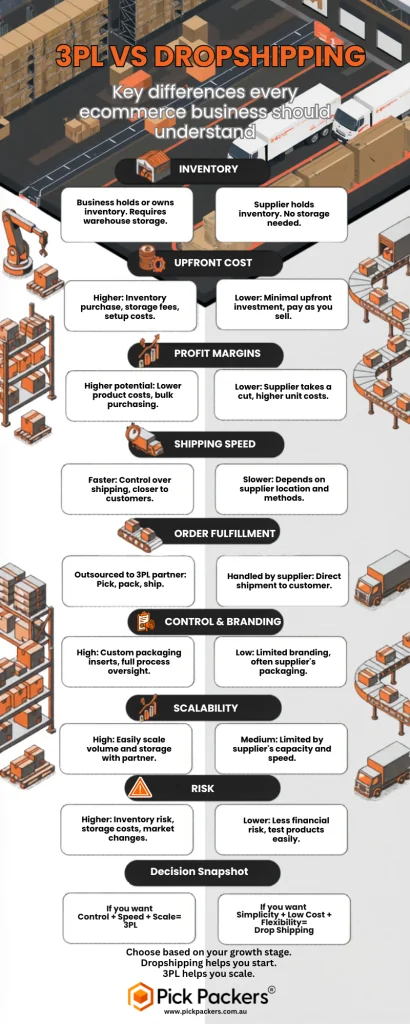
Both models serve the same purpose but operate very differently behind the scenes. The biggest differences come down to ownership, control, and scalability.
Here’s how they compare across core areas:
- Inventory ownership: 3PL requires you to purchase and store stock, while dropshipping relies on supplier inventory.
- Upfront costs: 3PL involves inventory and storage costs, while dropshipping has minimal startup expenses.
- Profit margins: 3PL allows higher margins through bulk purchasing, while dropshipping margins are often lower.
- Shipping speed: 3PL offers faster delivery through local warehouses, while dropshipping depends on supplier locations.
- Brand control: 3PL allows custom packaging and branding, while dropshipping limits presentation.
- Scalability: 3PL supports long-term growth, while dropshipping can struggle with consistency at scale.
- Returns management: 3PL providers handle returns efficiently, while dropshipping often complicates the process.
These differences become more noticeable as order volume increases and customer expectations grow.
Pros and Cons of 3PL
3PL works best for businesses ready to scale operations and improve delivery performance. It adds structure and reliability to fulfilment while supporting growth.
Advantages of 3PL:
- Faster delivery times through distributed warehouses
- Better customer experience with reliable shipping and tracking
- Higher margins from bulk inventory purchasing
- Scalable systems that handle increasing order volumes
Limitations of 3PL:
- Requires upfront investment in inventory
- Ongoing storage and fulfilment fees
- Less flexibility when testing new products
Pros and Cons of Dropshipping
Dropshipping lowers the barrier to entry and simplifies operations. It works well for early-stage businesses that want to test demand without large investments.
Advantages of dropshipping:
- No need to purchase or store inventory
- Easy to start with minimal setup
- Flexible product testing across different niches
Limitations of dropshipping:
- Lower profit margins due to supplier pricing
- Limited control over product quality and packaging
- Slower shipping times in many cases
- Dependence on supplier reliability
These trade-offs become more challenging as your business grows and customers expect faster delivery.
Which Is Better: 3PL or Dropshipping?
The better option depends on your stage of growth and your priorities. Each model solves a different problem, so the decision should align with your business goals.
Dropshipping works best when you need speed and flexibility at the start. It allows you to test products and validate demand without committing capital to inventory. This makes it a practical choice for new ecommerce stores still finding product-market fit.
3PL becomes the stronger option once your order volume increases. It gives you control over fulfilment, improves delivery speed, and strengthens your brand experience. Businesses focused on long-term growth often move toward 3PL to maintain consistency and scale efficiently.
When to Switch from Dropshipping to 3PL
Many businesses begin with dropshipping but outgrow its limitations as they scale. The transition to 3PL usually happens when fulfilment starts affecting customer experience and profitability.
Here are common signs it’s time to switch:
- Order volume is increasing and suppliers can’t keep up
- Delivery times are causing customer complaints
- You want better branding and packaging control
- Profit margins need improvement through bulk purchasing
Making the switch at the right time helps you maintain growth without sacrificing service quality.
Dropshipping vs 3PL: Bottomline
Dropshipping offers a fast and low-risk way to start an ecommerce business, but it comes with limitations in control and scalability. 3PL requires more upfront investment but delivers faster shipping, stronger branding, and better long-term growth potential.
Most successful ecommerce brands don’t choose one forever. They start with dropshipping, then transition to 3PL as demand increases and customer expectations rise.
FAQs: 3PL vs Dropshipping
Choosing between fulfilment models can raise practical questions, especially as your business grows. Here are clear answers to the most common concerns about 3PL and dropshipping.
What is the main difference between 3PL and dropshipping?
The main difference is inventory ownership and control. 3PL requires you to hold stock and outsource fulfilment, while dropshipping relies on suppliers to store and ship products directly. This means 3PL offers faster delivery and better control, while dropshipping focuses on low startup costs and simplicity.
Is 3PL more expensive than dropshipping?
3PL has higher upfront costs because you need to purchase inventory and pay storage and fulfilment fees. However, it often leads to better margins over time due to bulk purchasing and lower per-unit costs. Dropshipping is cheaper to start but can limit profitability as your business grows.
Can you switch from dropshipping to 3PL?
Yes, many businesses transition from dropshipping to 3PL as they grow. The shift usually happens when order volume increases, delivery speed becomes important, and brand control matters more. Moving to 3PL helps improve customer experience while supporting consistent and scalable fulfilment operations.
Which model is better for beginners?
Dropshipping is better for beginners because it requires little upfront investment and no inventory management. It allows you to launch quickly and test products without financial risk. Once your business gains traction, switching to 3PL can improve delivery speed, margins, and overall customer experience.
Do large ecommerce brands use dropshipping?
Most large ecommerce brands do not rely on dropshipping as their primary model. They use 3PL or in-house fulfilment to maintain control over inventory, shipping, and branding. Dropshipping is more common in early-stage businesses, while established brands prioritise reliability, speed, and customer experience.
Ready to ship? Send us a message.

Author: Will Adlouni
Will Adlouni brings over a decade of expertise at Pick Packers, where he leads in redefining logistics with tailored solutions that save clients an average of 30% on costs. Specializing in fulfilment, e-commerce, and online logistics, Will focuses on exceeding client expectations by automating the sale-to-delivery process and offering expertise in EDI, B2B, and B2C View all posts by Will Adlouni