
Key Takeaways:
- OMS centralizes orders, inventory, and customer data across all sales channels.
- Automation reduces errors and speeds up order processing and fulfilment workflows.
- OMS helps businesses scale with real-time visibility and smarter operations.
Managing orders across multiple channels quickly becomes complex as a business grows. Orders come from different platforms, inventory shifts constantly, and customers expect fast, accurate delivery. Without a system in place, errors and delays become harder to control.
An order management system, or OMS, solves this by bringing everything into one place. It connects orders, inventory, and fulfilment processes so businesses can manage operations efficiently while improving customer experience.
What Is an Order Management System?
An order management system is software that tracks and manages customer orders from the moment they are placed until they are delivered. It acts as a central hub where order data, inventory levels, and customer information are updated in real time.
Instead of handling orders manually across different platforms, an OMS allows businesses to manage everything from a single system. It connects ecommerce stores, warehouses, and shipping providers, helping teams process orders faster and with fewer mistakes.
For example, a business selling on Shopify, Lazada, and a physical store can use an OMS to track all orders in one dashboard. This removes the need to switch between systems and reduces the risk of overselling or missed orders.
How an Order Management System Works
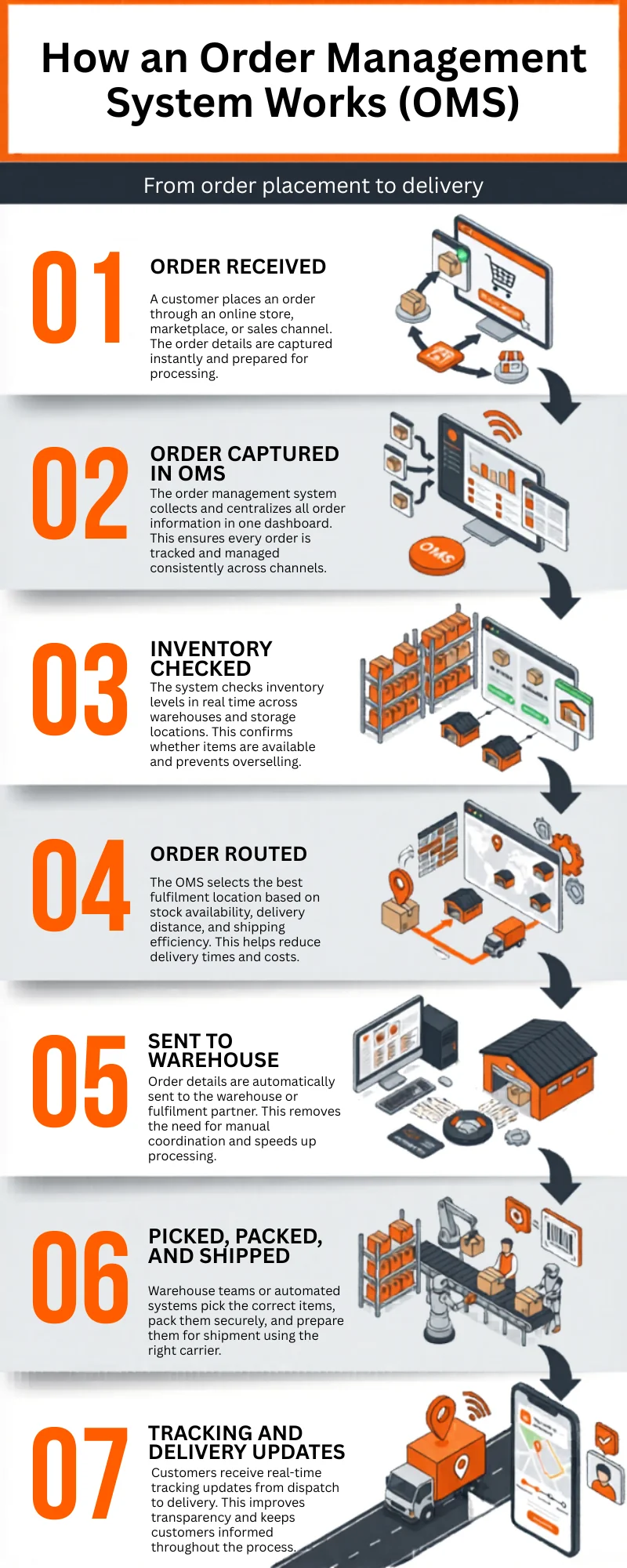
An OMS follows a structured process that keeps orders moving smoothly from purchase to delivery. Each step is connected, allowing data to flow automatically between systems.
Here’s how the process works:
- Order Capture
Orders are collected from multiple sales channels such as ecommerce platforms, marketplaces, or retail systems. - Order Validation
The system checks order details, payment status, and customer information before processing. - Inventory Check
Stock levels are verified in real time to confirm product availability across locations. - Order Routing
The OMS selects the best fulfilment location based on stock, proximity, or delivery speed. - Warehouse Processing
Orders are sent to a warehouse or fulfilment partner for picking and packing. - Shipping and Tracking
Shipping labels are generated, and tracking updates are shared with customers. - Returns Management
Returned items are processed, restocked, or refunded through the same system.
This connected workflow reduces manual work and keeps operations consistent, even during high order volumes.
Key Features of an OMS
An effective OMS includes several features that improve visibility and control across operations. These tools help businesses manage orders efficiently while maintaining accuracy.
Key features include:
- Centralized order dashboard that shows all incoming orders in one place
- Real-time inventory tracking across warehouses and sales channels
- Multi-channel integration with ecommerce platforms and marketplaces
- Automated order routing based on location and availability
- Customer notifications for order status and delivery updates
- Returns management tools for faster processing and restocking
Together, these features create a system that keeps order operations organized and scalable.
OMS vs WMS vs ERP
Order management systems often work alongside other operational tools. Each system has a different role, but they function best when integrated.
An OMS focuses on managing orders from start to finish. It handles order capture, routing, and customer communication.
A warehouse management system, or WMS, manages what happens inside the warehouse. It tracks inventory storage, picking, packing, and stock movement.
An enterprise resource planning system, or ERP, connects broader business processes such as finance, procurement, and reporting.
When these systems work together, businesses gain full visibility across operations. The OMS manages the order flow, the WMS handles execution, and the ERP supports decision-making.
Benefits of Using an OMS
Using an OMS improves both operational efficiency and customer satisfaction. It reduces manual processes while giving businesses better control over their order flow.
Here are the main benefits:
- Faster order processing through automation
- Fewer errors caused by manual data entry
- Accurate inventory visibility across channels
- Improved customer experience with real-time updates
- Scalable systems that support business growth
These benefits become more noticeable as order volumes increase and operations expand across multiple channels.
Who Needs an Order Management System?
As businesses grow, managing orders manually becomes harder to sustain. An OMS becomes valuable once operations involve multiple sales channels, higher order volumes, or complex fulfilment setups.
Businesses that benefit the most include:
- Ecommerce brands selling across multiple platforms
- Retail and wholesale businesses managing large order volumes
- Businesses expanding into new markets or regions
- Growing companies scaling their operations
Even smaller businesses can benefit from an OMS once order complexity begins to affect accuracy or delivery speed.
OMS and Fulfilment: How They Work Together
An OMS plays a central role in connecting order management with fulfilment operations. Once an order is placed, the system sends accurate information directly to the warehouse or fulfilment partner.
This connection ensures that orders are picked, packed, and shipped without delays or confusion. It also allows customers to receive tracking updates automatically, improving transparency.
When integrated with fulfilment systems, an OMS creates a smooth workflow from checkout to delivery. This reduces bottlenecks and keeps operations consistent even during peak periods.
Common Challenges Without an OMS
Without an OMS, businesses often rely on manual processes or disconnected systems. This leads to operational issues that affect both efficiency and customer experience.
Common challenges include:
- Order errors caused by manual entry
- Inventory mismatches across sales channels
- Delayed fulfilment and shipping
- Limited visibility into order status
These problems become more frequent as order volumes grow. An OMS helps eliminate these issues by centralizing data and automating workflows.
Order Management Systems: Bottomline
An order management system gives businesses control over their entire order lifecycle. It connects sales channels, inventory, and fulfilment into one streamlined process, reducing errors and improving speed.
As ecommerce continues to grow, managing orders efficiently becomes a competitive advantage. Businesses that invest in an OMS gain the visibility and structure needed to scale operations while delivering a better customer experience.
Order Management System FAQs
Understanding how an OMS works helps businesses decide when and how to implement one. Below are answers to common questions about order management systems and their role in modern operations.
What is an OMS in ecommerce?
An OMS in ecommerce is software that manages orders from placement to delivery. It centralizes order data, tracks inventory, and coordinates fulfilment processes across multiple sales channels. This helps businesses process orders faster, reduce errors, and maintain accurate stock levels while improving the overall customer experience.
How does an order management system work?
An order management system works by capturing orders, verifying details, checking inventory, and routing them for fulfilment. It connects with ecommerce platforms, warehouses, and shipping providers to automate each step. This reduces manual work, improves accuracy, and ensures orders move smoothly from purchase to delivery.
What’s the difference between OMS and WMS?
The difference between OMS and WMS is their function within operations. An OMS manages the order lifecycle, including order capture and routing. A WMS manages warehouse activities such as inventory storage, picking, and packing. Together, they create a complete system that supports accurate and efficient fulfilment.
Do small businesses need an OMS?
Small businesses need an OMS once order volume or complexity becomes difficult to manage manually. It helps organize orders, reduce errors, and improve delivery speed. As businesses grow, an OMS supports scalability by automating processes and providing better visibility across inventory and customer orders.
How does OMS improve order fulfilment?
An OMS improves order fulfilment by automating workflows and ensuring accurate data is shared with warehouses. It reduces delays, minimizes picking errors, and provides real-time tracking updates. This leads to faster processing, better inventory control, and a more reliable delivery experience for customers.
Ready to ship? Send us a message.

Author: Will Adlouni
Will Adlouni brings over a decade of expertise at Pick Packers, where he leads in redefining logistics with tailored solutions that save clients an average of 30% on costs. Specializing in fulfilment, e-commerce, and online logistics, Will focuses on exceeding client expectations by automating the sale-to-delivery process and offering expertise in EDI, B2B, and B2C View all posts by Will Adlouni