

Key Takeaways:
- A WMS tracks inventory and improves warehouse accuracy and efficiency.
- Real-time data and automation reduce errors and speed up fulfilment.
- A strong WMS supports scalable and efficient warehouse operations.
Warehouse Management System (WMS): Complete Guide
Modern warehouse operations move fast. Orders come in from multiple channels, customers expect quick delivery, and inventory must stay accurate at all times. A warehouse management system helps businesses stay in control by organising stock, guiding workflows, and keeping operations consistent from receiving to shipping.
As ecommerce continues to grow, manual warehouse processes become harder to manage. A WMS brings structure to this complexity by connecting inventory, orders, and fulfilment into one system. It improves visibility, reduces delays, and supports long-term operational growth.
What Is a Warehouse Management System (WMS)?
A warehouse management system is software that manages and tracks inventory within a warehouse. It helps businesses control stock levels, organise storage, and guide daily operations such as picking, packing, and shipping.
Instead of relying on manual tracking or spreadsheets, a WMS provides real-time updates on inventory movement. This allows warehouse teams to work faster and with fewer errors. It also gives business owners better visibility into stock levels, order status, and overall performance.
When Should Businesses Should Start Using 3PL Services?
Most businesses move to 3PL fulfilment when order volumes become difficult to manage in-house. This often happens when daily orders exceed what a small team can pack accurately or when storage space limits growth. Seasonal spikes, expanding product ranges, and rising delivery expectations also trigger the shift. For Australian ecommerce brands, outsourcing fulfilment often reduces delivery times by positioning stock closer to metro customers.
Steps to Start With 3PL and Fulfilment Services
Starting with a 3PL provider follows a structured onboarding process. Each step ensures systems, stock, and workflows align before live orders begin:
- Review order volumes, SKU count, and monthly growth trends
- Confirm platform integrations with ecommerce and inventory systems
- Define packing rules, shipping options, and service-level expectations
- Transfer inventory to the fulfilment centre and complete system testing
- Launch fulfilment with monitored orders before full-scale rollout
- Review order volumes, SKU count, and monthly growth trends
A clear setup phase prevents dispatch errors and reporting gaps later.
Costs and Considerations Before Outsourcing Fulfilment
3PL pricing usually includes storage, pick and pack fees, packaging, and shipping. Costs vary based on order complexity, item size, and monthly volume. Businesses should also factor in onboarding fees and returns handling. While outsourcing adds a service cost, it often replaces rent, labour, software, and carrier contracts. For many Australian businesses, the total cost becomes more predictable as order volumes increase.
How a Warehouse Management System Works
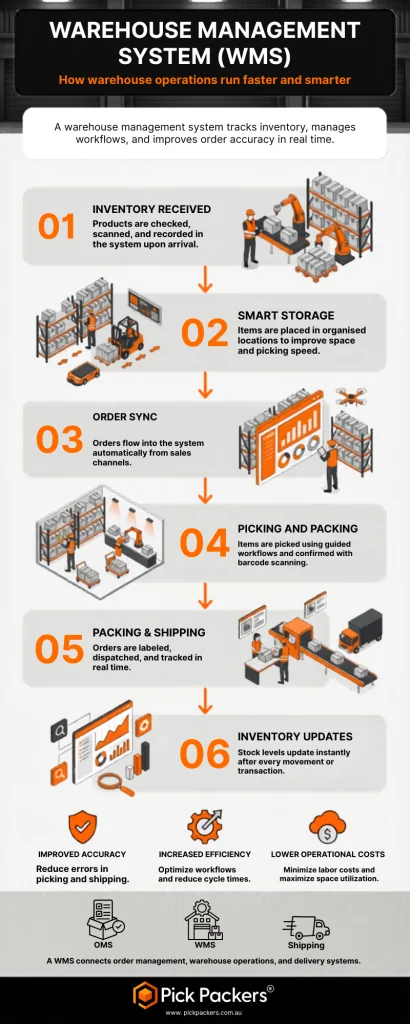
A warehouse management system follows a structured workflow that connects every stage of fulfilment. Each step is guided by real-time data, helping teams move inventory efficiently while maintaining accuracy.
The process typically includes the following steps:
- Inventory Receiving
Products arrive at the warehouse, where they are checked, scanned, and recorded in the system. This step ensures stock accuracy from the start. - Inventory Storage
The system assigns storage locations based on product type, demand, or warehouse layout. This improves space usage and reduces picking time. - Order Processing Integration
Orders from ecommerce platforms or systems flow into the WMS automatically. This keeps order data accurate and up to date. - Picking and Packing
Warehouse staff follow guided picking paths to locate items quickly. Barcode scanning helps confirm accuracy before packing. - Shipping Coordination
Orders are labeled, assigned to carriers, and prepared for dispatch. Tracking information is updated in real time. - Returns and Inventory Updates
Returned items are checked and restocked. Inventory levels adjust automatically after every movement.
Key Features of a WMS
A warehouse management system includes several features that improve operational control. These tools help businesses manage inventory more efficiently while reducing manual work.
Some of the most valuable features include:
- Real-time inventory tracking that updates stock levels instantly
- Barcode scanning to reduce picking and packing errors
- Order integration across multiple sales channels
- Reporting dashboards that show warehouse performance
- Multi-location inventory management for growing operations
These features work together to create a more organised and responsive warehouse environment.
Benefits of Using a Warehouse Management System
A WMS improves both daily operations and long-term performance. It helps businesses move faster while maintaining accuracy, even as order volumes increase.
The benefits include:
- Improved accuracy, reducing errors in picking, packing, and shipping
- Faster fulfilment, allowing quicker order processing and dispatch
- Better inventory visibility, helping avoid stockouts or overstocking
- Lower operational costs through reduced manual work and inefficiencies
- Scalable operations that support growth without increasing complexity
These improvements directly impact customer satisfaction and overall business performance.
Types of Warehouse Management Systems
Different types of WMS solutions are available depending on business needs, size, and complexity. Each option offers varying levels of control and integration.
The most common types include:
- Standalone WMS
A system focused purely on warehouse operations, suitable for businesses needing basic functionality. - ERP-Integrated WMS
A WMS that connects with enterprise resource planning systems, combining inventory, finance, and operations in one platform. - Cloud-Based WMS
A flexible solution that runs online, allowing real-time access and easier integration with ecommerce platforms.
Choosing the right type depends on how complex your operations are and how much flexibility you need.
WMS vs OMS: What’s the Difference?
A warehouse management system and an order management system serve different but connected roles. A WMS focuses on what happens inside the warehouse, while an OMS manages how orders are received, processed, and routed.
An OMS handles order flow across multiple sales channels, ensuring orders are captured and organised correctly. The WMS then executes those orders by managing inventory and warehouse operations. Together, these systems create a smooth and efficient fulfilment process.
Common Challenges and Solutions
Even with a WMS, warehouses can face operational challenges. Addressing these issues early helps maintain efficiency and accuracy as the business grows.
Common challenges and solutions include:
- Inventory inaccuracies
Use barcode scanning and real-time tracking to maintain accurate stock levels - Inefficient warehouse layout
Optimise storage locations based on demand and picking frequency - Manual processes
Introduce automation tools to reduce errors and improve speed - Data silos
Integrate systems to ensure consistent data across platforms
Solving these challenges helps maintain a reliable and scalable warehouse operation.
How to Choose the Right WMS
Selecting a warehouse management system depends on your business size, order volume, and growth plans. The right system should support both current operations and future expansion.
When evaluating options, consider:
- Integration with ecommerce platforms and existing systems
- Ease of use for warehouse teams
- Scalability to handle increasing order volumes
- Reporting tools for tracking performance
- Overall cost compared to long-term value
A well-chosen WMS becomes a long-term asset that supports efficiency and growth.
Warehouse Management System (WMS): Bottomline
A warehouse management system brings structure, visibility, and efficiency to warehouse operations. It helps businesses reduce errors, improve fulfilment speed, and maintain accurate inventory across every stage of the process.
As order volumes grow, a WMS becomes more than a tool. It supports scalability, improves customer experience, and keeps operations running smoothly in a fast-moving fulfilment environment.
Warehouse Management System (WMS): FAQs
A warehouse management system plays a central role in fulfilment operations. Below are clear answers to common questions businesses ask when considering a WMS.
What does a warehouse management system do?
A warehouse management system tracks and manages inventory within a warehouse. It controls stock movement, guides picking and packing, and updates inventory levels in real time. This helps businesses improve accuracy, reduce errors, and maintain efficient warehouse operations as order volumes increase.
Is a WMS necessary for small businesses?
A WMS is not always required for small businesses, but it becomes valuable as order volume grows. It helps organise inventory, reduce manual errors, and improve fulfilment speed. Businesses planning to scale often adopt a WMS early to avoid operational bottlenecks later.
What is the difference between WMS and ERP?
A WMS manages warehouse operations, while an ERP system manages broader business functions like finance and procurement. A WMS focuses on inventory movement and fulfilment, whereas an ERP connects multiple business processes. Many companies integrate both systems to improve visibility and coordination.
Can a WMS integrate with ecommerce platforms?
A WMS can integrate with ecommerce platforms to automate order processing and inventory updates. This connection allows orders to flow directly into the warehouse system while syncing stock levels across channels. Integration reduces manual work and helps maintain accurate, real-time data across systems.
How does a WMS improve order accuracy?
A WMS improves order accuracy by using barcode scanning, guided workflows, and real-time inventory tracking. These tools help warehouse staff pick the correct items and confirm orders before shipping. As a result, businesses reduce returns, prevent shipping errors, and improve customer satisfaction.
Ready to ship? Send us a message.

Author: Will Adlouni
Will Adlouni brings over a decade of expertise at Pick Packers, where he leads in redefining logistics with tailored solutions that save clients an average of 30% on costs. Specializing in fulfilment, e-commerce, and online logistics, Will focuses on exceeding client expectations by automating the sale-to-delivery process and offering expertise in EDI, B2B, and B2C View all posts by Will Adlouni